Showing posts with label money. Show all posts

Aug 16, 2006

money & happiness

Interesting article on money and happiness in the Wall Street Journal today (sub required).

It points out a 2004 survey that shows 43% of people with family incomes greater than $90K reported being very happy, but only 22% of people with family incomes below $20K were very happy. This would make you think that money does in fact make you happier. But in fact other studies add two new aspects to this information. First, after you are sheltered, fed, warm, and safe, more money doesn't really add to your happiness. Second, even though people who make more money say they are very happy, they don't feel happy most of the time. It just when they are asked if they are happy that they feel happy. In general higher income earners weren't happier but were more anxious and angry. Even worse, high income earners spend more time working, commuting, and doing obligatory non-work activities (e.g., maintaining their nice green lawns) which is a leading indicator of unhappiness. So higher income earners say they are happy but aren't really.

This led researchers to believe that it's not absolute wealth or income power that makes you say you are happy when asked, it's relative. Do you make more than your friends or neighbors or the average person? So in general high income earners are miserable but when asked if they are happy with their lot in life they feel they are doing better than most people and so they answer they are happy. Fascinating.

This effect should show up most clearly with women who now spend more time in the workplace and earn more money than they did, say, 30 years ago. And that's exactly what the data shows. 29% of women described themselves as happy in the 1990s down from 36% in the 1970s. Numbers for the men over that time period didn't move.

So what makes people happy? Researchers suggest the following:


  • Short commute times. Apparently we don't adapt well to this type of hardship because it is unpredictable. It's a constant source of unhappiness. My commute time is the same as with my previous job but much more predictable. It's also more productive since I'm not doing the driving. I agree this adds tremendously to happiness. I love not driving.
  • Choosing time over money. There apparently is no time decay to the happiness that more time brings. But there is a quick time decay to the unhappiness brought on by not having the money to buy things like a new car. A new car brings satisfaction and happiness for a short period of time. This is called 'hedonic adaptation' in the article which merely points out that researchers probably spend more time on naming things than studying them. I was lucky to find a job that gave me more leisure time and more money so I don't think I can comment on this one. Although I had a great car once and after a year it became a worry more than anything else.
  • Spend money on experiences. Experiences are better than durable goods. The experiences are short-lived but the memories aren't. I think my first post on this blog had to do with all the junk I'd accumulated. I ended up throwing it all out. I have very few possessions to my name now.
  • Use your leisure time wisely. Passive activities bring no enjoyment (e.g., TV). Socializing with friends over food brings the highest satisfaction which proves the French are onto something. I can easily get sucked into passive activities. I probably don't need to tell anyone I don't watch TV because of a vicious TV addiction I used to have. I'm much better off for it. I just hope reading is active because I do an awful lot of that and it brings me a huge amount of happiness.
A colleague brought the article to my attention stating that after he read it, he checked the byline to make sure I wasn't the author. That's the best compliment I've ever received.

Feb 3, 2006

ten percent

I've come across this heuristic that we need to save 10% of our income for retirement so many times that I finally decided to figure out if the number made any sense. I've posted before about how the average savings rate in the U.S. is actually around 0%. The reason I'm so interested in this is I'm wondering what happens down the road a few decades when social security is bankrupt and most people have no sources of income and no savings and they're nowhere knew death. Move in with the kids? Does 10% savings get us anywhere near where we need to be? Or is it like drinking 8 glasses of water a day where there is no basis in reality for the number.

I made a pretty simplistic model, but I took into account the big drivers - tax rates before and after retirement, capital gains taxes, asset appreciation, retirement at 65, etc. One important thing to keep in mind is that house equity can't necessarily be defined as savings in the analysis below. If you have equity of $100,000 in your home but your retirement home will cost $100,000 then that equity isn't 'savings'. I have retirement expenses going down 80% in the model because I assume your retirement house is paid off. Also I'm not including social security payments into this which I personally think is a good assumption.

The model assumes a 10% nominal or 7% real return on savings before retirement and a 7% nominal or 4% real return on savings after retirement. Let it be known I think these returns are aggressive contrary to what you read.

A few definitions of the columns below:

  • Savings Age - Age you start saving
  • Retire Age - Age you retire
  • Savings Rate - Percent of salary after taxes you save
  • Savings Run Out - Age your savings will run out
  • Save Ratio Age X - Ratio of Savings to gross salary you should have at that age
SavingsRetireSavingsSavingsSave RatioSave Ratio
AgeAgeRateRuns OutAge 40Age 50
216510.0%922.134.25
216514.3%Never3.046.07
215518.3%923.897.77
215522.6%Never4.819.60
356519.8%920.873.02
356527.2%Never1.204.15

In general I've got 3 pairs of results. The first 2 rows are 'normal saving'. The second two rows are 'early retirement'. And the last 2 rows are 'late saver'. And for each pair I have a 'support yourself to 92 years old' and a 'support yourself forever' (see Savings Runs Out column). The key column to look at is the Savings Rate.

In general saving 10% of your net income puts you in a pretty good spot. You can probably live to around 92 years old. And bumping your savings rate up to 14.3% allows you to not have to start rooting for a death at that age. You can live forever. A much more prudent number to shoot for.

Start later though and you'll be in a world of pain. Your savings rate needs to be up in the 20% range to get back to even. In fact if you wait until you are 35 and start saving 10% a year you will run out of money only 8(!) years after retiring (not shown). That is grim.

Retiring early is just as taxing. Again you have to hit 20% savings rates to think about hitting the beach while you still look good in a swim suit.

The final caveat is that my returns are constant each year. In reality that is not realistic. Consider 1966 to 1983. In '66 the Dow Jones hit 1000. In '83 it finally went to 1001. That's 17 years without a return. If you look at the end of that chart in the link you'll see we haven't moved much in a very similar manner for 6 years.

Nov 29, 2005

why didn't they tell me this in 9th grade?

I was reading a nice post on another website a few days ago about average incomes based on education level. I can't remember the site. It's one of the economic ones I read. Since I couldn't find it I just went to get the data at the census site. Here it is:


Avg. Income
9th-12th Grade$22,200
HS Diploma$30,084
Some College$35,160
Bachelor's Degree$53,356
Master's Degree$62,820
Doctorate Degree$88,589

This looks about what I'd expect, except for the doctorate being higher than a master's degree. I've always been told it was a nobrainer than a doctorate was a bad economic decision. What's not shown here though is what this actually means on a current value basis. To get that doctorate degree you have to spend more time in school not earning money and pay out more expenses during that time. There are a lot of assumptions you can make in this type of calculation but I'll keep it simple to just get an answer.

I'll use a discount rate of 10% (a little high perhaps). Assume a flat wage over the lifetime of the average individual (terrible assumption as it would start low and increase over time even in constant dollar terms) and use 75 years as the age of death and the point at which I terminate the calculation. I also won't use any costs associated with the education levels (again a terrible assumption but one whose effects you can ballpark later). And I'm adding a small income for the doctorate during the 5 years in school since I got paid when I got mine. I'm not sure if that's standard or not. So what are the results of the present value (brought back to age 16, the earliest individual in the sample)?


NPV of income
9th-12th Grade$243,398
HS Diploma$272,404
Some College$268,933
Bachelor's Degree$329,371
Master's Degree$320,096
Doctorate Degree$299,991

That's not a huge difference is it? Add in your tuition costs and it all seems to come off as pointless. Get out in 9th grade and work your butt off I say. There are assumptions I've made that make the higher education more attractive but I would have suspected these simplistic assumptions to produce a big difference. One aspect of this calculation is that your wealth is not linearly linked to this NPV. If you assume some minimum amount of income spent towards staying alive (shelter, food, etc.) then the lower NPVs suffer much more. If the NPV of your costs is $240,000 then the 9th grade drop out has no savings and the bachelor degree individual has some money to invest. Nevertheless I will not be showing this information to my daughter.

the simple things

Blueprint for retirement - save money, invest, have a bundle of money at age 65. This is a widely understood process. We know we need to put away some part of our paycheck and we know we need to invest those savings in some vehicle that grows. We're probably also aware of the next level of granularity around this process; things like asset allocation, diversification, etc. Even if not entirely understood, we've had this sort of information pounded into our heads over the years.

What's not clear is how much of this know-how has been converted to action. I know average savings are 0% of income right now. Not good. How about investing? Probably not good. I say this because I've just completed the utterly arduous process of consolidating assets (cash accounts, broker accounts, IRA accounts) into a single 'location' and setting up a process to have those assets administered professionally. I'm lucky in that this is done for me free of charge. Even with that incentive it's utterly painful. Without that help it would be worse. I'd need to spend a huge amount of time actually investigating specific processes to implement these ideas and then another huge amount of time implementing them. And to be honest what motivated me wasn't that it's the right thing to do. I did it because the alternative was more arduous. Basically my trades are tracked because of my job and I need signoff from a compliance committee for every trade. Every trade is therefore a headache of paperwork. Professional administration removes my need for signoff. Any way you cut it, the 'do-it-yourself' investing movement over the last decade has made sound money management easier but not easy.

Take just one aspect of management - asset allocation. What exactly is the right allocation? I've seen lots of pie charts outlining different strategies (often at odds with one another). First off, what exactly is the right set of asset classes to allocate against? There are a lot of dimensions - geographical, market cap, valuation/growth, volatility, bonds/stocks, etc. If I see an allocation that doesn't include geography, for example, does that mean I can invest 100% in U.S. assets? Add to this the fact that I had assets over a number of areas (even more before consolidating) - options, ESPP plans, real estate, 401Ks, etc. How do I make sure I'm including all these assets into my allocation decisions. More importantly how does real estate fit into all of this for the average person since a lot of wealth is tied up in that vehicle? How do I allocate against that asset?

And then when do I reallocate? I could reallocate every day since my percentages change daily. That will create a nightmare tax and trading cost situation. How about once per year? Surely there is some implementable right answer to this question. Lastly how important is allocation? In other words should I spend energy focusing on this or not given my time/energy constraints? What opportunity cost is represented by not allocating correctly?

I've learned a couple things through this process:
  1. While most people are concerned about these decisions they have neither the time nor the energy to do most of these activities or do them correctly. I know I didn't until recently. Yea I had money saved and invested into securities but it wasn't allocated, there was too much cash lying around, and it wasn't diversified on any metric. It was only a new child, free financial advisory/trading services, and a compliance headache that caused me to get on it.
  2. The energy and time spent on this overall process is probably not spent in the most efficient areas. If you trade stocks I'm sure more energy is spent on when/if to buy/sell Google than what is your true asset allocation at this moment. Do you spend more time looking at historical returns on your 401K options or just contributing a little bit to each fund, but ignoring rebalancing and understanding how your allocation pans out? I know I thought along those lines until now. Ultimately I think things like proper diversification, allocation and rebalancing, incorporating tax implications, and systematic investment of new cash assets is where the bulk of returns are gained versus picking that one killer stock that plays out once and a while or scoring the right set of 401K funds. Rebalancing after I did some back of the envelope calcuations seems like a huge and completely ignored aspect of money management for the individual investor.

As much as the 'do-it-yourself' movement has appealing overtones and as much as financial advisors are doing, in many cases, almost programatic activities, I think their value is that they actually do these simple things. They just happen to be expensive or unavailable to the average person.

I see our clients every once and a while. While many came into a large amount of cash due to external events, most aren't big cash generators from their jobs. They are just more systematic about saving money and investing it wisely. They are ruthless about it. Or at least ruthless about making us do some of these activities for them. While I think our firm has shown great stock picking ability, it's probably the account managers who manage client portfolios that add more value at the end of the day. Analysts provide headlines for marketing materials and account managers actually deliver value.

Now I just have to get moving on creating a will.

Sep 14, 2005

piggy banks

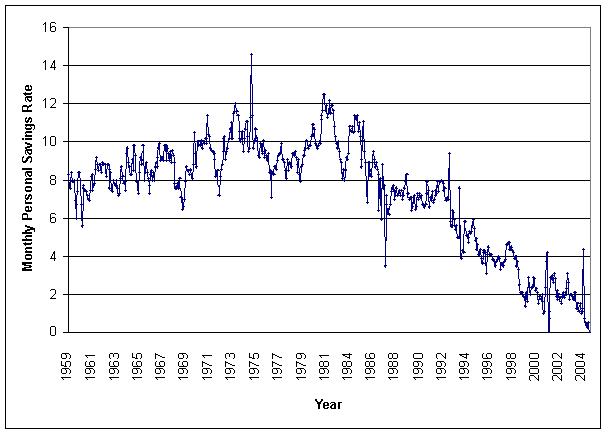
A few of the sites I read are talking about the U.S. savings rate today. I decided to go look at the data they were using myself. Savings rates are defined as total personal income minus total personal consumption over income. So spending a lot of money on your mortgage doesn't count. It's an amazing set of data. Not only because we are at zero savings rate but also because the trendlines change only over massive timescales. I would have though that 4 years ago or back in 1987 we would be saving a lot (after the market crashes). But that is not the case. Spending seems to be more related to some collective personality of the U.S. that has slowly changed over time. We have gone from a saving nation up until the mid 80s to an increasingly consuming nation ever since. Along the way we've used stock market asset increases and housing asset increase to fund this spending. But we are now at a limit that now requires us to borrow against our future earnings or our net current assets. Given the long time frames to change behavior it's not like we will be able to stop this increased consumption any time soon.

Mar 1, 2005

my new best friend

My hair has pretty much been every different length hair could be. I have had hair down to my back, a bobbish cut, a bit of pompadour, and now a buzz cut. Getting a buzz cut doesn't entail much. The barber goes over your head with an electric clipper and trims the edges a little and you are done. Consequently my haircut costs have gone down over the years to the point where I pay $13 bucks at Astor Place Hair. But even this began to niggle at me because when you have a buzzcut the damn thing is shot by the end of 2 weeks.

So last weekend I made the plunge and popped for a clipper. I did a little research and found Wahl was a brand that most professionals used. It was tough to locate but the clipper itself was surprisingly cheap - $50. At that rate I cover my costs in about 3 months or so. Seems like a pretty good investment.

The first thing I noticed about the clipper when I got it home was how old school it was. I almost guarantee these guys haven't changed the fundamental design in 30 years or so. I bet barbers would throw a hissy fit if they did. It is a total throw back to the 50's. Classic styling coupled with an industrial weight and construction. It is a solid piece of engineering which is something you don't find all that often nowadays.

I must admit a certain amount of trepidation upon first placing the clippers on my noggin' with a number 2 guard on. A number 2 guard isn't all that much. Maybe 3/16 of an inch? I'm not sure. Either way there's not a lot of error between having hair and having a freshly mowed patch down the middle of your head. I started tentatively on the sides and worked my way to more vital areas. Pretty simple. Took about 5 minutes and to be honest the overall job is even better than a barber because I spend the time to get every single little hair that might stick out cropped off. I'm not quite as good at tapering to a 1 guard on the sides and back but maybe I can employ my wife for that task in the future. There's something warm and fuzzy about being able to give yourself a haircut for no money.

Dec 7, 2004

what was I thinking

Now that I spend most of my time analyzing stocks (job) it scares me to think that I actually invested my own money at one point. I really didn't even do a cursory amount of analysis of any of the stocks I bought since I began investing.

That's one of the reasons my job is so interesting. Today I'm reading a sell-side tome on hard drives. Some poor bastard spends his whole time thinking about how companies involved with hard drives make money. Me? I just read about it on the weekend.

Take a hard drive. Pull it apart. You've got a few basic components. The read head that writes and reads bits, the media that stores the bits, you've got some housing around the actual drive, and an ASIC chip that helps the drive interpret the bits and operate correctly, some screws, some plastic mounting components, and an assortment of other various components. Now. Which piece has the best operating margins and the best return on equity? In other words, if you started a company, which part would you want to make? Naturally you'd gravitate towards the higher tech components. Perhaps the ASIC or the read head. Turns out the plastic mounting components and the screws had, by a wide margin, the best operating margins (~18%) and the best ROE (~20%). The worst? The ASICS and the read head.

It's a weird result but in most cases accelerated technological advancement seems to lead to such quick obsolescence and such high capital costs that it's tough to make money except for a few standout companies such as Intel. Combine that with the fact that no one wants to go into business making low tech parts. It's almost like an artificial barrier to entry. Want to raise money for a new chip? Much easier. Thus too much competition. In fact our fund generally makes most of its money shorting the really high tech stuff and going long the crap no one would possibly want to own or get into. Buy low sell high - Short high cover low.

Dec 3, 2004

PSA Take 2

Update on free credit reports. The three companies are being a little sneaky. You are entitled under the Act to get all 3 reports from all 3 major credit agencies. The online process however only sends you to one agency to get one report. You have to go back to the beginning and select another agency and repeat to get the other ones. It's worth doing because the three don't cross check data. So a clean report from Experian for example does not mean Equifax's is clean.

PSA Take 1

Free credit report This is actually not a scam. As part of the FACT Act everyone is due a free credit report once per year. It's run by the big 3 credit reporting agencies - Equifax, TransUnion, and Experian. Only hitch is it's being phased in over the year. Western states get the first crack at it. 3 months from now the Central's go.

Now while it can be worth looking at to see how bad or good your finances are. The better reason to check this is that it is most likely addled with errors. And as part of the FACT Act you are entitled to a simple streamlined process to correct those errors. Given that most financial institutions (credit card companies, mortgage lendors, etc.) look at this stuff, it makes sense to check everything is in the okay.