Showing posts with label science. Show all posts

Sep 7, 2011

a victory for fossil fuels

People are dumb, panicky dangerous animals and you know it. - MIB

People popping potassium iodide tablets
Chinese hoarding iodized salt

I suspect Fukushima will have a larger impact on anti-nuclear sentiment than the much more catastrophic Chernobyl accident. Primarily because it was not a man-made issue. Scientists can no longer say "poor design", "poor procedures", "poorly trained workers", etc. This was a random dice being thrown and coming up 7.

All energy production requires tradeoffs.
  • Coal is estimated to kill 30,000 a year.  I suspect it much higher than this. It liberates nasty radioactive particles and radiation.  The CO2 it produces will eventually kill 100s of millions if it isn't removed from our gen grid.
  • Hydroelectric is one of the best but dams are not immune from earthquake damage. Oh you didn't hear about the dam that failed in the Sendair earthquake and flooded a town of 1,800.  Not surprising.  While that wasn't a power dam it's shows the damage it can do. How about Banqiao Dam. 18GW dam that failed.  26,000 died from the flooding and 145,000 died from subsequent epidemics and famine. Finally in the US at least our hydro is tapped out.  We are actually losing hydro due to environmental lawsuits which dislike the damage to the environment they create.
  • Natural gas is very clean.  Still produces a lot of CO2 though.  About half as much as coal. The "fracking" of shale rock however is done in a manner that could be screwing with our water table. Unclear what the effects of this are.  Plus it's incredibly price volatile.
  • Wind is outright one of the cheapest to build and operate.  But it too has issues.  There aren't a ton of great sites to place wind gen.  We've tapped out Western Texas to the point where T Boone Pickens just up and left his projects there to die.  And generally the wind blows where people aren't.  Ever driven through West Texas?  That means transmission lines and those are both pricey and also unbelievably hard to build in the US.  10 year lead times.  Plus it generally blows at night when no one is really using power.  One way to offset this is with batteries but then you have an expensive energy solution again.  Plus it is not dispatchable.  You can't just create energy from wind turbines when you need it.  It stops blowing and there is very little forewarning.  This is a strain on the operation of the grid and against costs money.  Plus some potentially biased sources claim that more people die per wind MWh produced compared to nuclear.
  • Solar is like wind.  Non-dispatchable, generally runs where people aren't, and unfortunately is still pretty pricey without massive subsidies.  Plus it is not immune from environmental concerns either.  Silicon production is a dirty business.  And thin films used Cadmium.  Ugly stuff.  
  • Geo is almost perfect.  It's dispatchable, deadly cheap to run, and no CO2 or any other environmental issues that we are aware of.  The problem seems to be that the current technology has limited site applicability.  I personally don't understand why this is.  We are good at drilling.  We have the oil and gas industry to thank for that.  But that doesn't seem to make the capital costs work out or how to apply technology to capture the heat.  Hopefully we'll figure that out one day.
So that means I like nuclear right?  I think people having a pro or anti nuclear position are making this way too simple.  There are good reactor designs and bad ones (1st gen BWRs).  There are good procedures and bad ones.  I like some of the new designs a lot.  And I'm not against closing down dangerous reactors.  And I think a lot more could be done.  Like an international SWAT team that can be deployed in situations like Chernobyl and Japan quickly and with "best of" practices and tons of mitigating procedures and equipment.  Quite frankly from what I've read Japan would never have been an issue if they would have dropped a good portable generation solution down on the plant while the batteries were being used.  I still don't know why this didn't happen.  

Nuclear power is dangerous stuff.  But it has some great attributes.  You can build big plants in small areas, it's cheap to run, there is no CO2, and it is dispatchable.  We need that in our arsenal.  And there are some interesting designs out there like,

Integral Fast Reactors. They in theory pull most of the energy out of the uranium or thorium compared to 1% for current reactors.  You read that right.  They can "burn" our nuclear waste.  The fission byproducts half shorter half-lifes.  They operate at ambient pressures (no chance for pressure explosions).  The salt cooling system can be passive and operate purely by convection from the heat from the reactor.  A loss of power to these reactors doesn't lead to dire consequences.  They are self-regulating.

As the reaction heats up it causes neutrons to escape reducing the reaction and heat generated.  Are there issues?  Of course.  There are always issues.  The sodium burns in air and explodes in water which of course is in the turbine.  It also produces precursors to weapons grade plutonium.  This was the reason the initial work by the US was shut down in 1994. In 2001 the DOE tasked scientists to evaluate the best reactor designs.  IFR was #1.  There are none in operations but some prototypes exist. And of course more work needs to be done.  You may be familiar with one configuration.  Bill Gates has backed a traveling wave reactor concept.

It's all part of a portfolio of imperfect energy tools we have.  I don't like the idea of throwing one out.

Sep 1, 2011

wall-e

Wall-E, I mean Opportunity rover, landed on Mars on January 2004.  While its sister, Spirit, died a while back, that crazy thing has been going for over 7 years now.  30 TIMES LONGER THAN IT WAS SUPPOSED TO.

Aug 19, 2011

i don't buy it

13-Year-Old Makes Solar Power Breakthrough by Harnessing the Fibonacci Sequence

This was the top-ranking post on popurls.com today.  Sounds wonderful.  It'd be great if some breakthrough was made.  The kid is certainly smart and ambitious.  Problem is the whole breakthrough reads like bullshit.  I read through his 'report' which didn't go through peer review and it just sounds completely hokey.  The write-up sounds way too composed for a 7th grader.  That's fine his dad helped.  The sketches and drawings are ripped right from the illustrations in Wikipedia.  Fine we all use Wikipedia.

More problematic is the whole thing makes zero sense from a physical and geometric perspective.  Because he doesn't have a real research paper it's hard to understand his true physical setup and experimental procedure but it seems he's not measuring against a 'best-in-class' setup.  You certainly wouldn't build a roof and put cells on BOTH sides.  That cuts efficiency by around 50% right there. He's measuring volts instead of watts.  He hasn't taken into account the massive costs associated with the structure.  By default he has to string the PV in series which means an inverter for each panel (more cost, a lot more).

Even worse it's crazy how wholesale this story has been published and commented on in glowing terms.  People don't even have basic science skills to question this at all.  And it's kind of a flat out insult to the people attempting to do research in this area who work hard to improve these technologies.  This kind of article always has that implicit tinge of disdain for the scientists in a field. "Look this kid showed up all these researchers."

I'm happy to be proved wrong in this but I think we'll find out this was a hoax or is total bullshit in short order.

[Update] Well Gizmodo has published an article claiming that someone has posted a takedown of the science.  Unfortunately the blog post was in turn taken down presumably by the poster.  Google cache here. The gist is measuring voltage is wrong because it's not related to power and then the geometry of the test case is inefficient. The blog by the way is a really interesting read.  Loads of stuff on power gen.

[Update] Unfortunately the entire blog has been shuttered.  I guess the guy didn't want the notoriety.

Jun 24, 2011

shocking

Damn,

First we learn bikes do not stay up due to gyroscopic forces. (bonus: epic experiments)

Now we learn our concept of static electricity is fundamentally flawed.

Next thing you know they'll discover cold isn't the absence of heat but the abundance of cold.

More disillusionment here.

May 31, 2011

for crying out loud

What is this bullshit.

"WHO: Cell phone use can increase possible risk"

Ignore for now the ridiculous title ("can...possible"). Check out this quote from the report (which I can't find anywhere on WHO's site).

"What microwave radiation does in most simplistic terms is similar to what happens to food in microwaves, essentially cooking the brain. So in addition to leading to a development of cancer and tumors, there could be a whole host of other effects like cognitive memory function, since the memory temporal lobes are where we hold our cell phones."

You hear that? cell phones are cooking your brain. And causing cancer. Even though it's neither intense enough to cook nor an ionizing radiation to break DNA bonds. Please explain how this happens WHO.

May 26, 2011

cognitive dissonance

How does the same person write these two articles?

Phys Ed: Why Doesn’t Exercise Lead to Weight Loss?

Less Active at Work, Americans Have Packed on Pounds

How? How is that possible? Barely 1.5 years apart. It might be possible if the second article referenced some caveats as pointed out in the first article. But it doesn't. I find this bizarre. And it is a reason I don't take Tara Parker-Pope's articles seriously. Because she's clueless.

May 12, 2011

ka-boom

Those interested in The Atlantic's photojournalism piece on nuclear testing should check out Trinity and Beyond on Netflix.

Most of the shots in the Atlantic's piece can be viewed in video. Especially interesting is the video of that first shot where a bomb is launched from a traditional canon.

The Shat provides commentary. The footage is unbelievable. Plus you get to see how thin Americans once were. Finally, in case it wasn't known, we set of an ungodly amount of nuclear bombs in the atmosphere.

Mar 23, 2011

aurora

Uh. Wow! The shot with the car with it's lights on and the one with the aurora behind the wispy fast moving clouds. Amazing. You should check out some of his other videos.

Mar 22, 2011

kennedy space center

I'm a certified space junkie. Certified. Being an astronaut was the first thing I recall wanting to do. I don't recall ever being jealous of anyone or anything they had or had done except for two guys I met on separate occasions. Both were Flight Controllers for the Space Shuttle. Awesome!

Anyway we took a  trip down to Disney World recently and spent one day at Kennedy Space Center. I hadn't been there since 1974 or thereabouts (that's me below). There wasn't much. Some items from the Apollo, Gemini, and Mercury programs lying around in a field.

It has changed quite a bit since then. It's a real attraction now run by a private company. The main center has a rocket garden with about 20 rockets assembled. The shuttle and main launch rockets are there and you can go inside. And you can also take a tour around the facilities. This is highly recommended. The tour takes you past the main buildings. You can see the administrative facilities including where the astronauts come out. They take you past the VAB, or Vehicle Assembly Building (the big iconic building). They take you past the crawler tracks and the Shuttle launch facilities (39A & 39B). And if you are lucky like we were there will be a Shuttle (Discovery) on the launchpad. Awesome. Plus alligators everywhere. Double rainbow!

Finally they drop you off at a second center that houses the REALLY cool stuff. You have to go on tour for this. Inside is the full Saturn V rocket (friggin huge!), the Apollo 14 command module, moon rock, actual space suits (e.g., Shephard's suit), and a ton of other stuff. I could have stayed for days.

I learned a few things on the trip.
  1. The shuttle undergoes a "nod" or "twang" (in NASA parlance). About 6 seconds before the Solid Rocket Boosters (SRB) are lit the three main engines on the shuttle itself are lit. This sudden thrust is off the center of mass of the entire shuttle construct and thus produces a torque. This torque forces the shuttle to nose down because the entire construct is being bent. The displacement is about two meters and is quite noticeable if the camera is reasonably close. When it snaps back the SRBs are lit. You can see it clearly the movement in this video. If you keep an eye on where the tip is in relation to the clouds you can see it roll nose down and then when it comes back to center the SRBs are lit and it takes off.

  2. For the early shuttle missions the entire shuttle construct was all white. Later the main center fuel tank, known as the external tank, became orange. The reason for this is that NASA stopped painting it white to save 600 lbs of weight. It's orange to save weight.
  3. The space shuttle down-throttles the engines when it hits a spot in the atmosphere (about 35,000 ft) referred to as Max q. "q" is just the dynamic pressure on the hull and is a function of both air density and vehicle velocity (q = f(air density, speed). At launch the velocity is zero so the dynamic pressure is zero. In space the density is zero so the dynamic pressure is zero. Somewhere as the velocity increases and the density decreases q hits a maximum point. This down-throttling is to alleviate pressure differences on the external tank hull that would cause it to collapse. Less thrust means more internal pressure so it keeps "inflated". After passing this spot it thrusts back up. This is when the Columbia disintegrated.
  4. The reason the SRBs are recycled and the external tank isn't is because the SRBs come off first. The fall into the ocean near the launch site. The main tank is released much later and comes down in the Indian ocean. Too far away to collect and send back for processing.
  5. Also this is kind of obvious but the external tank (the orange part) is just that; a tank. There is no engine at the bottom. It feeds the 3 main engines on the shuttle. It's a disposable gas tank.
  6. The Saturn V rocket (the one used in the Apollo missions) used 5 F1 Engines in the first stage of launch. One F1 engine has more thrust than all 3 main engines on the space shuttle combined. It however has less thrust than the solid rocket boosters. Those things are propulsion beasts. Only downside is SRBs can't be turned off.
  7. The Saturn V rocket was tested only twice (Apollo 4 and Apollo 6, both unmanned) before a fully manned flight was made (Apollo 8). Apollo 6, the second test, the one before they put people in it, was filled with serious problems. Stage 1 had serious pogo oscillations and Stage 2 had 2 (of 5) main engines shutdown.
  8. All the spacesuits are disintegrating. The plastic parts are made from PVC softened by an agent. The agent seeps out and becomes brittle. At KSC Alan Shepard's suit is kept in a dark room to minimize decay. Eventually they will all disintegrate. There is no way to stop it.
  9. When the Space Shuttle takes off you can see sparks being sprayed under the three main engines on the shuttle. I always thought this was how they lit the fuel mixture. But it is actually to burn up any stray hydrogen or oxygen that may accumulate around the engine.

Mar 21, 2011

leaking into the sea

Bloomberg has an article out titled, "Nuclear Plant's Fuel Rods Damaged, Leaking into Sea" (no I'm not linking to this piece of shit article). WTF people. What a disingenuous article title. Have we not progress over these last few days to get our basic fucking physics correct or are they being purposely obtuse. If the fuel rods were "leaking" into the sea they'd have to be rolling down the hill or melted corium dripping down the hill. TEPCO said fuel rods were damaged and releasing material that is contaminating the air and sea. That's different from what "leaking" implies.

No. What's happening is the volatile isotopic elements are coming out in either the steam, smoke or both. That stuff is settling into the ocean and they are picking it up in their readings. The concern here is that it gets on a piece of algae and then a small fish eats that algae and next thing you know your hamachi & hirame chirashi is fucking glowing. Not good.

Ironically it'd be best if they were rolling down the hill into the sea because you know what the sea is? A giant spent fuel rod cooling pool that will never boil dry. Plus water is so good at shielding radiation that that stuff wouldn't emit an iota of radiation (to people or fish) until they went back in there to fish them out. And I'm pretty sure the fish aren't interested in big long fuel rods as an appetizer. Rolling into the sea would be a best case scenario.

fast

Kids seem preoccupied by the most of something. The biggest number, the biggest thing, the tallest building. Currently my daughter is fixated on fast things. Here they are.

The fastest things in the world....

Man - (Usain Bolt) 27 mph
Land Animal - (Cheetah) 70 mph
Fish - (Sailfish) 70 mph
Bird - (Peregrine Falcon) 242 mph
Production Car - (Bugatti Veyron) 269 mph
Boat - (Spirit of Austrlia) 317 mph
Train - (TGV) 357 mph
Car - (ThrustSSC, Jet) 763 mph
Jet Plane - (Blackbird) 2,242 mph
Rocket Plane - (X-15) 4,519mph
Fastest thing - (Light) 670,616,629 mph

Apparently that wasn't good enough.

Eater - (Joey Chestnut) 330 hph (hot dogs per hour)
Bat - (Mexican Bat) 40/80 mph (horizontal/diving)

Mar 19, 2011

radiation and its effects

Nice talk here by a professor on radiation, isotopes, and radiation effects.  I'll just caveat that the guy who answers some of the Q&A at the end with an accents says things that are just dead wrong.  The main speaker seems tight and says he doesn't know stuff when he doesn't know it.

things are looking up

Things have been kind of quiet on the news front lately with respect to Japan. But that's probably a good sign that our disaster happy media doesn't have much to write about.

  • Power regained at reactors 1 & 2. This should allow them to gain full measurement and control capabilities and then focus on cooling.
  • Sprayers doused reactor 3's cooling pool, the temp is below 100C and they noted a decreasing dose rate near that reactor. However the reactor is not fairing as well and it is likely they will need to vent to reduce pressure.
  • Holes were made in the outer buildings of reactors 5 & 6 to reduce likelihood of hydrogen explosions and cooling of the spent fuel pools is back online. Temps are around 60C.
  • Unclear what is going on with 4. But clearly power is available nearby. Perhaps the spent fuel pool cooling system is intact in that building and can be operated soon.

If things keep progressing like this hopefully Japan can soon focus on the real disaster. 7,200 deaths, nearly 11,000 people still unaccounted for, many homeless, and in many places nonexistent basic infrastructure.

Mar 18, 2011

hydrogen leaks

There's an interesting theory over at All Things Nuclear - Link - about the hydrogen explosions. Most have been portraying the explosions as part and parcel of the venting process. But the question being ignored is why the fuck would you vent it inside the building? Some have said the operators did it to lengthen the time the off gas lingered inside (and thus amount of radionuclides that decay) before going into the atmosphere. Perhaps.

But what ATN thinks happened is that the top of the reactor known as the drywell actually lifted off its moorings enough to open a small gap to allow steam (and hydrogen) to escape. It happened during a test at a US power plant under much safer conditions. It's a little bit frightening to think the primary container on the reactor could really be breached that easily. But if it's true it allows the operators to vent safely in the future. Namely don't let the pressure get as high as it did before.

The only potential flaw in this theory that I can see is that at the test plant the pressure stabilized (because the reactor was leaking).  If the containment pressure stabilized I would think the operators would not vent.  That they would wait for it to hit some predetermined point.  And it seems unlikely that those two points would be the same.  Interesting nonetheless.

Mar 17, 2011

funny if it wasn't sad

I don't watch TV but this is an example of the shit being spewed on it.  This guy is so hopelessly wrong about so many things it's ridiculous.  And he's an ex-nuclear engineer!  Ugh.

Mar 16, 2011

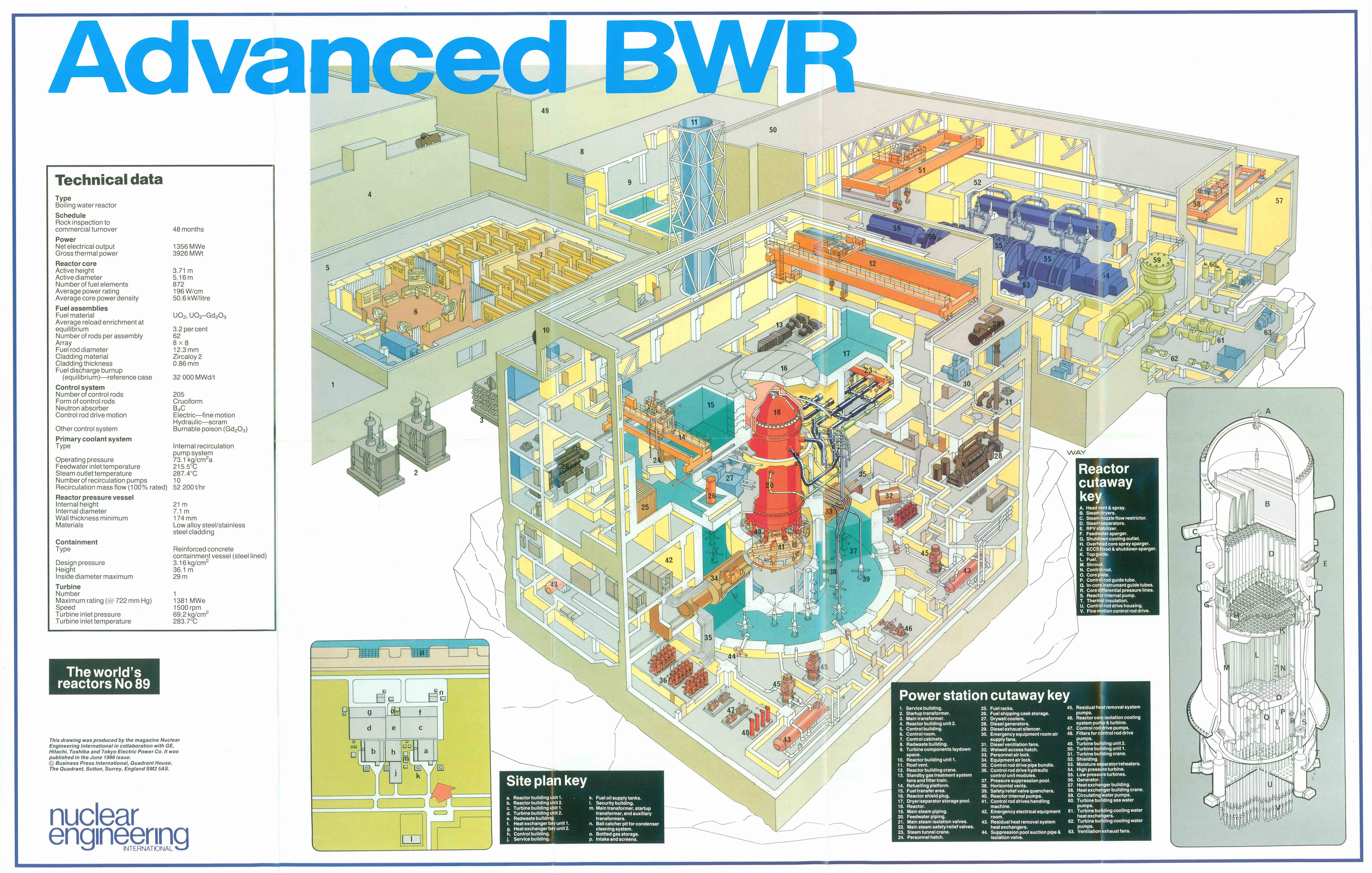
cutaways and other data

Cutaway of the TEPCO BWR Reactors.
Linkie

This is a nice cutaway but its of a different reactor.  However it's useful to get a better sense of the layout of a nuclear reactor.  This is an ABWR which is a better and more recent design.
Linkie

Some decent sources for reading and news report verification.

Mar 15, 2011

corium

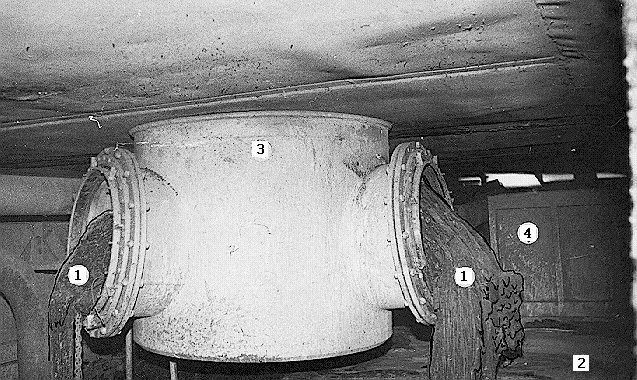
Add corium to your Scrabble arsenal.  It's basically a lava-life fluid comprised of very hot fuel rods, control rods, and other parts of melted reactor vessel.  It's a potential end game for the Japanese reactors.  In the case of Three Mile Island the corium did not ultimately breach the reactor vessel.  In Chernobyl it did.  Or more correctly it got "outside" the reactor core because it, well, blew up.

Here's a picture of it as it oozed out of a pressure release valve in Chernobyl and then solidified.

not so much

The Energy Collective article that was sent around as an accurate description of the Japanese nuclear reactor situation has now been modified. The original author was an economist. Not a nuclear engineer. This wasn't originally clear. The modified and now presuambly accurate post is still in the same location. Here.

In other news the plant has been abandoned due to radiation levels. It's unclear what the endgame is now. It is possible the primary containment vessel may hold the fuel rods as they heat up. It's also possible the vessel could explode from pressure. It's also possible that it may just burn through the bottom without an explosive event and be contained by the concrete bowl built beneath it. Or it could go through that. We'll just have to see how much cooling was accomplished. Or it's possible the workers return. That seems to have happened. Good news.

spent fuel pools

Add this to your reading list. A new potential issue in Japan has arisen base on the spent fuel pools. To be brief, after fuel rods are spent they are transferred to the spent fuel pool to further cool. To do this the rods are arranged in a specific manner and cooled to avoid going critical. Critical in the fission sense, not the atomic bomb sense.

The water does a number of things:

  1. It shields the radiation from the spent fuel from harming anyone.
  2. The water is recirculated to keep the fuel rods in a cooling mode
There are some reports that the pool in #2 and/or #4 are damaged (leaking water) or that they were neglected and the water boiled off (partially or otherwise).  There's no verification of this however.  Ultimately this could be a much bigger issue than the core reactor because recooling them could be difficult (too hot).  These pools contain a lot of spent fuel rods and if they heat up they can melt.  If they melt they'll sink to the bottom of the pool and be in such a dense, close packed configuration that they could go critical and start generating heat again.  This would be bad.  But as of yet I don't see any confirmation other than some reports that #4 had a fire that some are suggesting was started by the spent fuel rods igniting and/or producing hydrogen and detonating.

units 1 and 3 differences

The explosions on the reactors are quite different in magnitude.

Here's unit 1 on 3/12/11:


Here's unit 3 on 3/14/11:


This sat shot show much more damage to unit 3 with obvious steam leakage.  A hydrogen explosion is not big deal (apart from the people there).  It's possible something else happened at Unit 3.